

Steel grating stair treads(also known as stair treads or steel ladder treads)are stair‑specific components manufactured from steel grating. They are made by welding load‑bearing flat bars and cross bars into a rigid grid structure. Compared with traditional concrete stairs or solid steel plate stairs, steel grating stair treads offer outstanding advantages: light weight, high strength, slip resistance, water permeability, quick installation, and corrosion resistance. They are the ideal choice for stairways and access platforms in industrial plants, power stations, chemical plants, wastewater treatment facilities, offshore platforms, and many other demanding environments.
1. Key Features

High load capacity – Load‑bearing flat bars and cross bars are fused by high‑pressure resistance welding, creating a strong structure capable of supporting personnel, tools, and light equipment.
Slip‑resistant safety – The surface can be supplied with serrated anti‑slip finish, offering a friction coefficient of ≥0.6, suitable for wet and oily environments.
Drainage and no water pooling – The open‑grid design allows rainwater, oil, and small particles to fall through directly, preventing water accumulation and ice formation.
Lightweight and fast installation – Modular products can be installed either by welding or bolting, delivering high construction efficiency.
Long service life – Hot‑dip galvanised or stainless steel materials provide a service life of 15–25 years in industrial environments.
2. Material Options
| Material | Recommended Applications |
|---|---|
| Carbon steel + hot‑dip galvanising | General industrial stairways – best cost‑effectiveness |
| Stainless steel 304 | Food processing, municipal engineering, general wet environments |
| Stainless steel 316L | Coastal areas, chemical plants, marine engineering – highly corrosive environments |
| Aluminium | Weight‑sensitive applications (e.g., ships, mobile platforms) |
Note: Stainless steel does not require additional anti‑corrosion coating. Carbon steel must be hot‑dip galvanised.
3. Surface Finishing Options
| Finishing Method | Features | Best For |
|---|---|---|
| Hot‑dip galvanising | Strong corrosion protection, silver‑grey finish. Most commonly used. | Most outdoor industrial environments |
| Painting / powder coating | Custom colours to match equipment or architectural style. | Indoor or decorative applications |
| Pickling and passivation (stainless steel) | Removes surface oxides, restores corrosion resistance. | Standard treatment for stainless steel |
4. Installation Methods
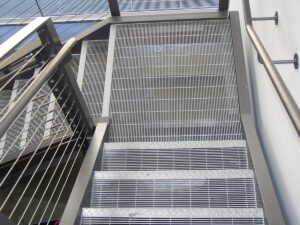
Welding – Treads are welded directly to the stair stringers. Strong, reliable, low cost. Suitable for permanent installations.
Bolting – Holes are drilled on both sides of the tread, and bolts are used to connect to the stringers. Easy to remove for maintenance.
Recommendation: After welding, apply a zinc‑rich paint or silver paint to the weld areas to prevent rust.
5. Application Scenarios
Steel grating stair treads are widely used in power plant boiler platforms, chemical plant pipe rack walkways, wastewater treatment plant stairways, offshore platforms, mine accessways, food plant maintenance ladders, and many more.
6. Quick Selection – Three Steps
1. Check the environment
-
Indoor, dry → carbon steel + hot‑dip galvanising
-
Outdoor / wet → hot‑dip galvanising
-
Coastal / chemical → 316L stainless steel
-
Food / pharmaceutical → 304 stainless steel
2. Check the load
-
Personnel only → standard specifications
-
Equipment or vehicles → thicker flat bars
3. Check the installation
-
Permanent → welding
-
Needs maintenance → bolting

If you have a procurement requirement for steel grating stair treads, simply provide the stair dimensions, service environment, and load requirements, and we will recommend the most suitable specification and material at no cost. Customisation according to drawings is supported. Enquiries are welcome at any time.