

Steel grating stair treads leave the factory as “black steel” – bare steel without any surface treatment. Bare steel will rust rapidly in industrial environments, so surface finishing is the critical factor determining the service life of the treads. Different surface finishing methods vary enormously in corrosion protection, appearance, cost, and suitability. This article analyses the common surface finishing options for steel grating stair treads in detail, helping you make the right choice.
1. Hot‑Dip Galvanising
What is it?
Hot‑dip galvanising involves degreasing, pickling, and fluxing the steel grating, then dipping it into molten zinc at approximately 445°C to form a zinc‑iron alloy layer plus a pure zinc layer on the steel surface. This is the most common and mature surface finishing method in the steel grating industry.
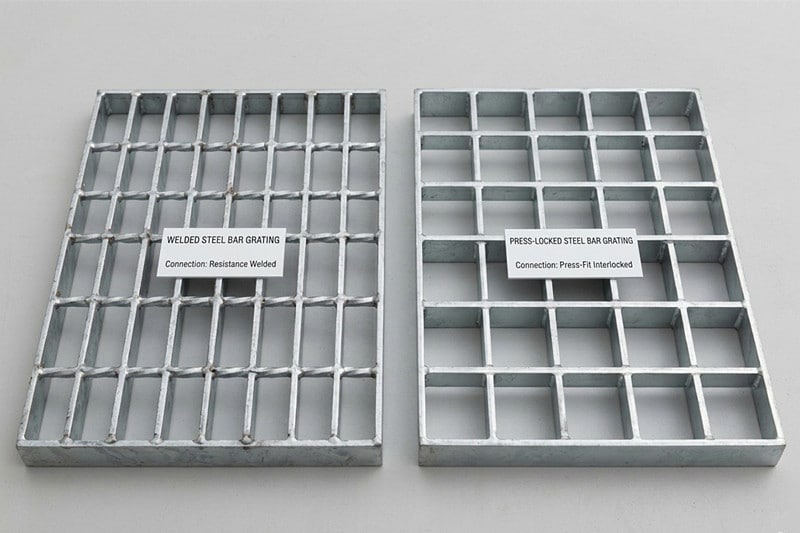
Advantages:
-
Strong corrosion protection – Zinc layer thickness far exceeds electro‑galvanising, giving dozens of times better corrosion resistance. Within the pH6–12.5 range, the zinc layer forms a stable protective film
-
Long service life – Hot‑dip galvanised steel grating can last 20–50 years in normal outdoor conditions
-
Strong adhesion – The zinc‑iron alloy layer forms a metallurgical bond with the base material and does not peel off
-
One‑shot process – The entire piece is dipped, so weld points and cut edges are protected(provided all processing is completed before galvanising)
Disadvantages:
-
Appearance less smooth than electro‑galvanising – noticeable process watermarks and minor zinc drips
-
Higher initial investment – requires specialised galvanising equipment and production lines
Zinc layer thickness standards:
According to GB/T 13912 and industry practice, hot‑dip galvanised layer thickness requirements are:
| Flat Bar Thickness | Average Zinc Layer Thickness | Average Zinc Layer Weight |
|---|---|---|
| 1.5mm–3.0mm | ≥55μm | 355–390g/m² |
| 3.0mm–6.0mm | ≥70μm | 460–530g/m² |
| ≥6.0mm | ≥85μm | ≥600g/m² |
Hot‑dip galvanising is generally carried out after the edging process.
Best applications: Almost all outdoor industrial stairs, power plant platforms, wastewater treatment plants, mine accessways – for outdoor environments, hot‑dip galvanising is the first choice.
2. Electro‑Galvanising(Cold Galvanising)
What is it?
Electro‑galvanising uses electrolysis: in a zinc‑ion electrolyte, the steel grating serves as the cathode and a zinc plate as the anode. Direct current deposits zinc ions on the steel surface to form a zinc layer. Unlike hot‑dip galvanising, electro‑galvanising is carried out at room temperature.
Advantages:
-
Smooth appearance – bright, uniform, even coating – no zinc drips or lumps
-
Lower cost – relatively inexpensive
Disadvantages:
-
Very thin zinc layer – typically only 10–15μm, while hot‑dip galvanising achieves 70μm+
-
Poor corrosion protection – far inferior to hot‑dip. In wet conditions, the zinc layer peels off easily and the grating rusts quickly
-
Poor acid/alkali resistance – the zinc layer depletes rapidly in acidic or alkaline environments
Best applications: Electro‑galvanised steel grating is generally only suitable for indoor dry environments, such as interior treads, decorative items, and tools. Not recommended for outdoor or any wet environment.
3. Paint Coating
What is it?
Anti‑rust paint(typically red oxide primer)is sprayed onto the steel grating surface, forming a protective film that prevents corrosive agents from reaching the steel. Custom colours are available on request.
Advantages:
-
Low cost – cheaper than galvanising
-
Custom colours – can match equipment or architectural style
Disadvantages:
-
Short service life – the paint layer is thin, wears and peels easily, requiring frequent maintenance
-
Moderate rust protection – vulnerable to scratching; bare steel rusts quickly once the paint is damaged
-
Poorer adhesion than galvanising – paint adheres physically, not metallurgically
Best applications: Generally used in indoor northern environments, or where colour coordination is important for architectural decoration. Not recommended for outdoor or high‑wear environments.
4. Powder Coating
What is it?
Fine powder coating material(typically epoxy powder)is sprayed evenly onto the steel grating surface, then heated to melt and cure into a dense coating layer. This is a popular method among overseas customers.
Advantages:
-
Aesthetic appeal – rich colour options, customisable
-
Corrosion resistant – dense coating, good acid/alkali resistance
-
Wear resistant – the plastic layer is tough and more durable than paint
-
No exposed weld points – coating covers all welds for good integrity
Disadvantages:
-
Higher cost – more complex production process, costs more than hot‑dip galvanising
-
Longer lead time – more process steps, slower delivery
-
Rapid corrosion if coating is damaged – once the coating is breached, the base material corrodes quickly
Best applications: Architectural decoration, equipment matching where aesthetics matter, and colour‑coded facilities. Suitable for indoor or mildly corrosive outdoor environments.
5. Dip Coating(Plastic Coating)
What is it?
The steel grating is heated and dipped into plastic powder(e.g., polyethylene PE), coating the surface with a plastic layer. Typical process: pre‑treatment → pre‑heating(320°C–370°C)→ dipping → curing(180°C–200°C)→ cooling.
Advantages:
-
Good rust resistance – plastic coating completely isolates air and moisture
-
Acid/alkali resistance – good resistance to acid and alkali corrosion
-
Glossy appearance – bright and attractive
-
Good insulation – and slip‑resistant, wear‑resistant
Disadvantages:
-
Prone to deformation at high temperatures – the dipping process involves high heat, which can deform steel grating, especially at corners
-
Coating thickness – affects the grid opening dimensions
-
Limited colour choices
Best applications: Outdoor stadiums, playgrounds, parks – where aesthetics and corrosion protection matter more than precision. More commonly seen in export orders.
6. Stainless Steel(No Additional Surface Treatment Required)
Strictly speaking, stainless steel is not a “surface finishing” method but a material choice. However, because stainless steel is inherently corrosion‑resistant and requires no additional galvanising or coating, it is often considered a “maintenance‑free” option in practice.
Stainless steel stair treads are typically manufactured from 304 or 316L stainless steel. After welding, pickling and passivation can be carried out – dipping in an acid bath and using a passivating solution to restore the protective film damaged during processing. The pickled surface has a matt off‑white finish. For higher gloss, electrochemical polishing can be applied.
Best applications: Food processing, pharmaceutical, coastal, chemical – highly corrosive environments.
7. Other Surface Finishing Methods(Rarely Used)
1. Thermal spraying(aluminium/zinc spraying)
Molten zinc or aluminium wire is atomised into fine droplets and sprayed onto the steel surface using thermal spray equipment. This offers corrosion protection comparable to hot‑dip galvanising. Suitable for large workpieces that cannot be hot‑dip galvanised, or for on‑site repair.
2. Dacromet(zinc‑chromium coating)
A composite coating of zinc/aluminium flakes and chromate. Withstands temperatures up to 300°C. Suitable for high‑temperature applications such as automotive production lines. In recent years, environmentally friendly chromium‑free passivation technologies have also emerged.
8. Comparison and Selection Guide
| Finishing Method | Corrosion Protection | Appearance | Relative Cost | Best Applications | Recommendation |
|---|---|---|---|---|---|
| Hot‑dip galvanising | Excellent | Silver‑grey with zinc pattern | Medium | Outdoor, wet, industrial | ★★★★★ |
| Electro‑galvanising | Poor | Bright, smooth | Low | Indoor dry, temporary use | ★★ |
| Paint coating | Moderate | Custom colours | Low | Indoor, decorative use | ★★★ |
| Powder coating | Good | Rich colours, smooth | Medium‑High | Indoor/outdoor decorative, equipment matching | ★★★★ |
| Dip coating(plastic) | Good | Bright | Medium‑High | Outdoor sports facilities, landscape | ★★★ |
| Stainless steel(pickling & passivation) | Excellent | Matt or bright | High | Food, chemical, marine | ★★★★★ |
Selection recommendations:
-
Outdoor industrial stairs – hot‑dip galvanising is the first choice – best value and longest life
-
Indoor dry environments – electro‑galvanising or paint coating is sufficient – lowest cost
-
Colour requirements – paint or powder coating – custom colours available
-
Food, pharmaceutical, coastal, chemical – use stainless steel(304 or 316L)directly – no additional finishing needed
-
High aesthetic requirements – powder coating or polished stainless steel
-
High‑temperature environments – consider Dacromet coating
Our recommendation: For the vast majority of steel grating stair tread applications, hot‑dip galvanising is the most reliable and economical choice. If you are unsure which surface finishing method to choose, simply tell us the service environment(indoor/outdoor, wet/dry, chemical exposure)and we can recommend the most suitable option free of charge.